
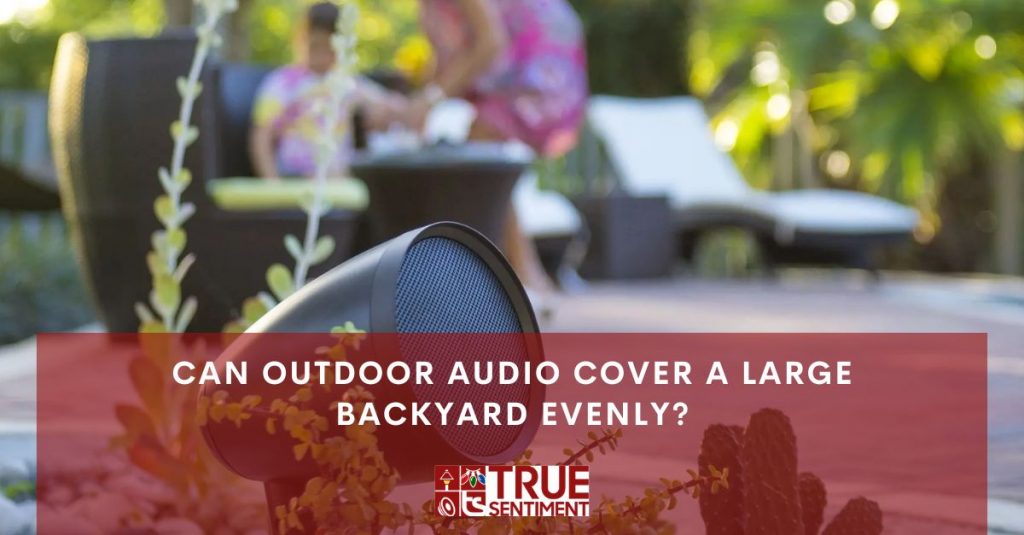
The good news is that covering a large outdoor space with even, high-quality audio is entirely achievable. It just requires the right equipment, a thoughtful layout, and—more often than not—a professional who knows the terrain. This post breaks down exactly what goes into a well-designed outdoor audio system, why even coverage is so difficult to achieve without expert planning, and how homeowners in Southern California are solving this problem for good.

Why Outdoor Audio Is Harder Than Indoor Audio
Indoors, walls, ceilings, and floors contain and reflect sound. That natural boundary actually works in your favor, helping to distribute audio more evenly throughout a room.
Outside, sound disperses freely in every direction. There are no walls to contain it, no ceiling to bounce it back. Wind, humidity, and ambient noise—traffic, birds, neighboring yards—all compete with your speakers. As a result, the same speaker that sounds perfectly balanced in a showroom can feel weak and uneven when placed in a wide-open backyard.
Backyard size makes this even more complex. A small patio with one pair of stereo speakers may work fine. But once you’re dealing with a larger space—say, 2,000 square feet or more—a single speaker cluster will almost always create dead zones and hot spots.
What Creates Uneven Sound Coverage in a Large Backyard?
Several factors work against even audio distribution in large outdoor spaces:
Distance attenuation: Sound naturally loses energy as it travels. The further you are from a speaker, the quieter the audio. This is the primary cause of dead zones in backyards with a single speaker source.
Speaker dispersion patterns: Every speaker has a specific coverage angle—the area where it projects sound effectively. Place a speaker with a narrow dispersion angle in a wide-open yard, and coverage drops off sharply at the edges.
Obstacles and landscaping: Trees, hedges, walls, pergolas, and outdoor kitchens all block or absorb sound. What works on paper can sound completely different once your landscaping is factored in.
Volume compensation: Homeowners often try to solve dead zones by turning the volume up. But louder isn’t the same as more even. Cranking the volume creates an uncomfortably loud zone near the speakers while still failing to reach the far corners of the yard.
What Are the Most Effective Outdoor Speaker Configurations for Large Backyards?
There’s no single configuration that works for every backyard. The right setup depends on the shape of the space, how it’s used, and the landscaping involved. That said, a few approaches tend to deliver the most consistent results.
Distributed Speaker Networks
Rather than relying on one or two powerful speakers, a distributed system places multiple smaller speakers throughout the yard. Each speaker covers a smaller zone at a moderate volume, and together they create seamless, even audio across the entire space.
This approach is widely considered the gold standard for large residential backyards. The audio feels immersive rather than directional—you hear music around you rather than coming at you from one place.
In-Ground and Landscape Speakers
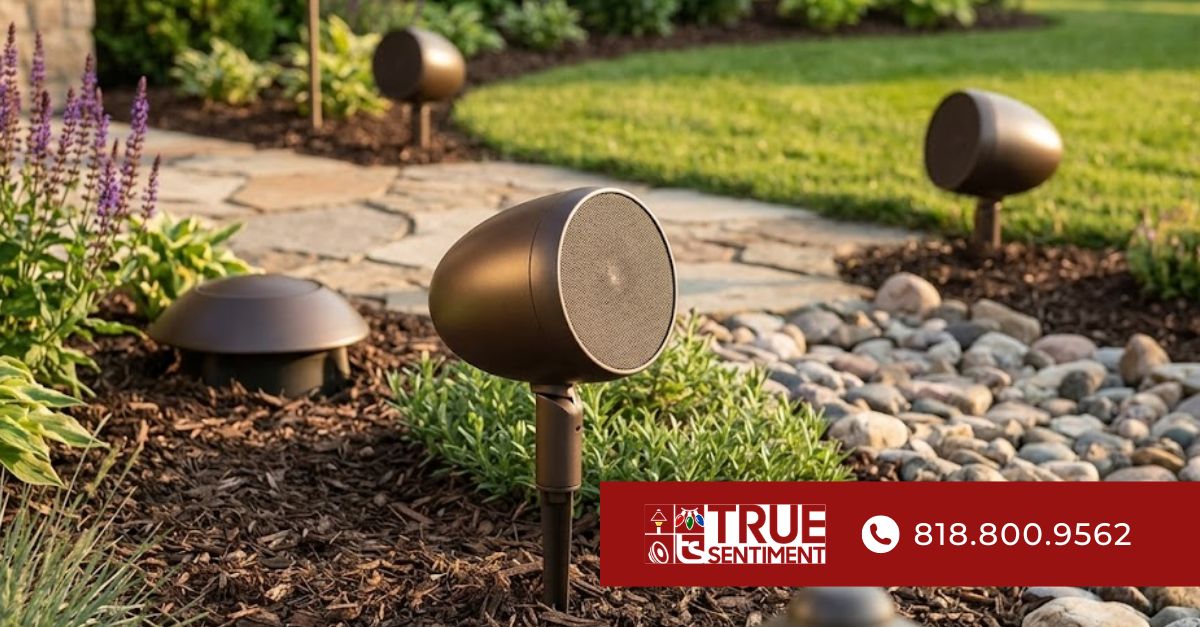
Landscape speakers are designed to blend into outdoor environments. Some are mounted on stakes, others built directly into the ground or disguised as rocks or garden features. When positioned strategically, they provide consistent coverage without cluttering the visual aesthetic of the yard.
For homeowners who’ve invested in professional landscaping, this is often the preferred solution. The speakers disappear into the environment, and so does the audio—in the best possible way.
Subwoofer Integration
Bass frequencies travel differently than mid and high-range sounds. In a large backyard, low-end audio can feel weak without a dedicated outdoor subwoofer. Integrating one (or more) into the system fills out the sound and prevents that thin, tinny quality that plagues many residential outdoor setups.
Zoned Audio Systems
Larger properties often benefit from dividing the yard into audio zones—patio, pool area, lawn, garden—each with its own speaker and volume control. Zoned systems allow you to run music at different levels in different areas, which is useful when part of the yard is quieter (a sitting area, for example) and another is more active (a pool or outdoor kitchen).
How Many Speakers Does a Large Backyard Actually Need?
The honest answer: it depends. A general rule of thumb is that speakers should be spaced no more than their effective coverage distance apart—typically 8 to 12 feet for smaller landscape speakers, and further for larger units.
For a backyard of roughly 1,500 to 2,500 square feet, a distributed system of four to eight speakers is common. Larger properties may require more, particularly if there are multiple distinct zones or significant landscaping that interrupts sound travel.
Speaker placement matters as much as quantity. Two well-placed speakers can outperform six poorly positioned ones.
Does Speaker Quality Make a Difference Outdoors?
Significantly. Outdoor speakers face conditions that indoor equipment simply doesn’t—UV exposure, moisture, temperature swings, dust, and insects. Speakers not rated for outdoor use will degrade quickly, affecting both sound quality and longevity.
Look for speakers with an IP rating (Ingress Protection), which indicates resistance to water and dust. All-weather or marine-rated components are ideal for exposed areas, particularly in climates where rain, salt air, or intense sun are regular factors.
Audio components also need to be matched correctly. Mismatched amplifiers and speakers lead to distortion, reduced output, and potential equipment damage. A professionally designed system accounts for impedance matching, power ratings, and signal distribution to ensure everything works together correctly.
What Does a Professional Outdoor Audio Installation Actually Involve?
A proper outdoor audio installation starts well before any wiring or speakers are involved. The process typically includes:
- Site assessment: A technician evaluates the yard’s size, shape, landscaping, and intended use to determine the best configuration.
- System design: Speaker placement, wiring runs, amplifier selection, and zone layout are planned to optimize coverage and minimize installation disruption.
- Infrastructure installation: Conduit, wiring, and mounting hardware are installed—ideally before any hardscaping or landscaping is finalized.
- Component installation and calibration: Speakers, amplifiers, and control systems are installed and tuned to the specific acoustic properties of the space.
- Integration: Modern outdoor audio systems can integrate with smart home platforms, allowing control via app, voice assistant, or a central control panel.
The True Sentiment team has completed custom outdoor audio installations across residential and commercial properties throughout Los Angeles and Southern California. Each project is designed around the specific dimensions, aesthetics, and lifestyle of the property—not a generic template.
Getting the Most Out of Your Outdoor Audio System
Once the system is installed, a few habits will help maintain quality over time. Have the system professionally calibrated annually, particularly after landscaping changes that may affect speaker placement or acoustic conditions. Keep outdoor speakers clean and free of debris. If your system includes an outdoor amplifier or receiver, ensure it’s housed in a weatherproof enclosure.
Is Even Coverage in a Large Backyard Worth the Investment?
For anyone who uses their outdoor space regularly—for entertaining, dining, or simply relaxing—even audio coverage transforms the experience. The difference between a speaker blasting from one corner and music that surrounds you naturally is significant.
A distributed, professionally designed system eliminates the dead zones, the volume battles, and the aesthetic compromise of visible speakers cluttering a well-designed yard. When done correctly, the audio becomes part of the outdoor environment rather than a distraction from it.
If you’re ready to explore what a custom outdoor audio system could look like for your property, True Sentiment’s team is available for consultations across Los Angeles and Southern California.